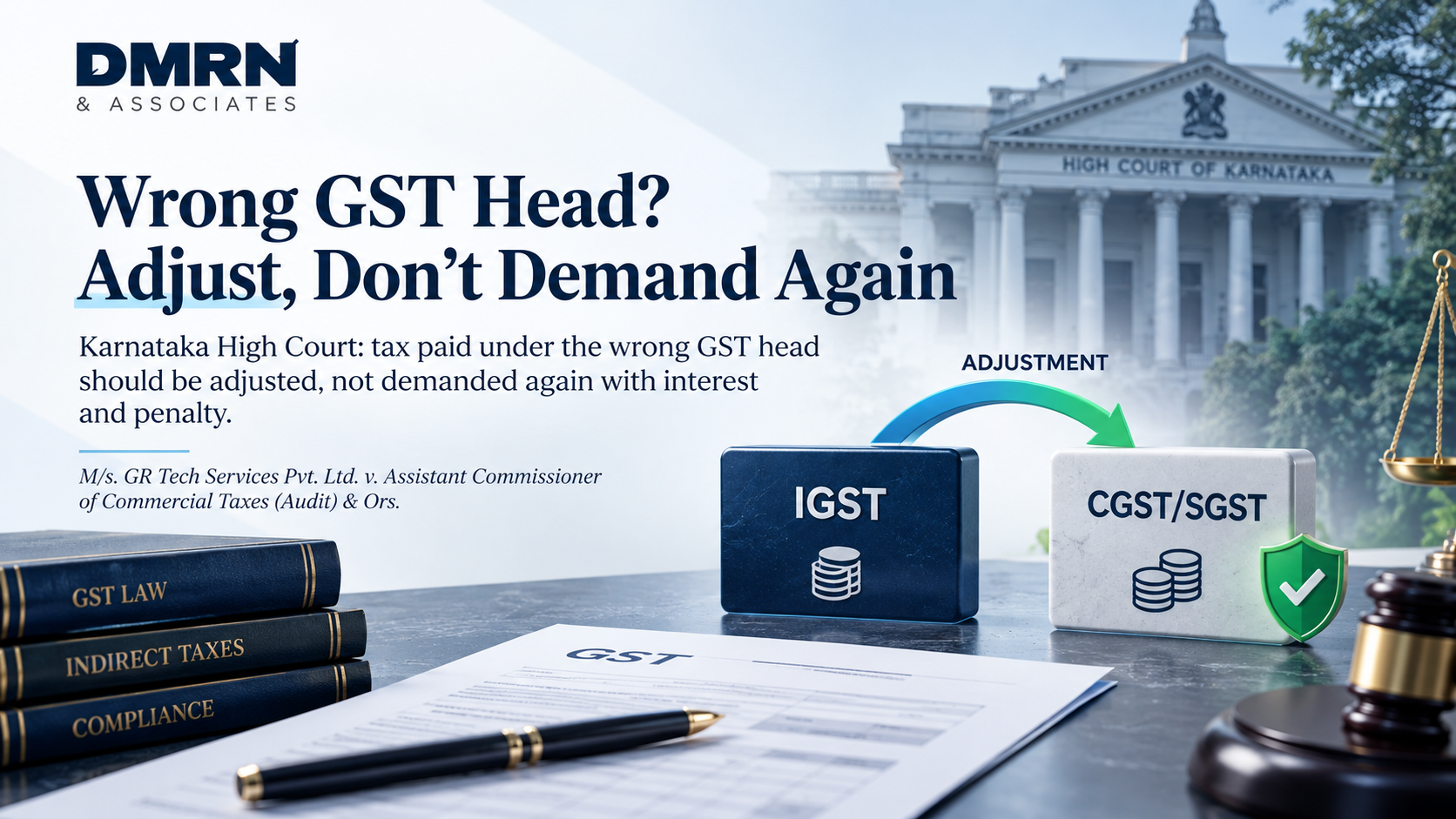
Tax Paid Under the Wrong Head Cannot Trigger a Fresh Demand: Karnataka High Court Directs Adjustment of IGST Against CGST/SGST Liability
M/s. GR Tech Services Pvt. Ltd. v. Assistant Commissioner of Commercial Taxes (Audit) & Ors. — Writ Petition No. 15670 of 2026 (T-RES), Karnataka High Court
AT A GLANCE
• Karnataka High Court quashes a GST demand raised on the ground that IGST was remitted instead of CGST/SGST, holding the issue to be one of adjustment, not fresh recovery.
• Section 77(2) of the CGST Act, read with Rule 92 of the CGST Rules, requires the tax paid under the wrong head to be adjusted against the correct head — without insisting on fresh payment, interest or penalty.
• Adjudication Order, Order-in-Appeal and the consequential DRC-13 demand all quashed; matter remanded for a fresh, reasoned order in the prescribed form.
In GR Tech Services Pvt. Ltd. v. Assistant Commissioner of Commercial Taxes (Audit) & Ors., the Karnataka High Court allowed the taxpayer's writ petition in part, quashed the adjudication order, the appellate order and the consequential demand, and remanded the matter for fresh consideration in light of Section 77(2) of the Central Goods and Services Tax Act, 2017 read with Rule 92 of the CGST Rules, 2017.
• GR Tech Services Pvt. Ltd. (“the Petitioner”) supplied services to Larsen and Toubro Limited, which maintained units at both Bengaluru and Chennai, during the tax period 2019-20.
• For the initial months, invoices were raised on the vendor's Chennai unit, treating the supplies as inter-State supplies, and IGST was discharged accordingly.
• On realising that the invoices ought to have been raised on the Bengaluru unit — the supplies being intra-State in nature — the Petitioner filed its returns offering CGST/SGST liability instead.
• On audit, the Revenue Department took the view that the Petitioner had remitted tax under the wrong head (IGST) and was obliged to first pay tax afresh under the correct head (CGST/SGST), and only thereafter claim a refund of the IGST paid, relying on Section 77(1) of the CGST Act.
• An Adjudication Order dated July 30, 2024 was passed under Section 73(9) of the CGST Act; the appeal against it was dismissed on limitation vide Order-in-Appeal dated June 24, 2025, culminating in a demand in Form GST DRC-13 dated May 06, 2026.
• The Petitioner's parallel refund application for the IGST paid was rejected on the technical ground that it had been filed before the CGST/SGST authorities, whereas the IGST itself had been offered on inter-State invoices.
• Aggrieved, the Petitioner approached the Karnataka High Court by way of writ petition, contending that Section 77(2) of the CGST Act read with Rule 92 of the CGST Rules mandated adjustment of the tax already paid under the wrong head against the liability under the correct head, without any fresh levy of tax, interest or penalty, relying on the Kerala High Court's decision in Saji S., Proprietor, Adithya and Ambadi Traders v. The Commissioner, State GST Department, Thiruvananthapuram & Ors. [WP(C) No. 35868 of 2018, dated November 12, 2018].
Whether IGST paid on a supply initially treated as inter-State, but subsequently held to be intra-State, can be adjusted against the corresponding CGST/SGST liability — or whether the taxpayer must first pay tax afresh under the correct head, together with interest and penalty, before pursuing a separate refund of the amount paid under the wrong head.
The Karnataka High Court, in Writ Petition No. 15670 of 2026 (T-RES), allowed the writ petition in part and held as under:
• Section 77(2) of the CGST Act stipulates that a registered person who has paid integrated tax on a transaction considered by him to be an inter-State supply, but which is subsequently held to be an intra-State supply, shall not be required to pay any interest on the tax payable under the correct head.
• The Kerala High Court in Saji S. (supra) had read Section 77 of the CGST Act in conjunction with Rule 92 of the CGST Rules, which contemplates adjustment of a refundable amount, requiring that where a refund is completely adjusted against an outstanding demand, an order recording such adjustment be issued in Part A of Form GST RFD-07.
• The original authority had not read Section 77(2) of the CGST Act together with Rule 92 of the CGST Rules while raising the demand along with interest and penalty — a conjoint reading that was, on the undisputed facts, plainly attracted.
• Applying that conjoint reading, the Petitioner could not be fastened with liability to pay tax, interest or penalty merely because it had initially offered IGST instead of CGST/SGST; the original authority was therefore required to examine the Petitioner's entitlement to adjustment and pass a fresh, reasoned order in the prescribed form.
• Accordingly, the Adjudication Order dated July 30, 2024, the Order-in-Appeal dated June 24, 2025, and the demand in Form GST DRC-13 dated May 06, 2026 were quashed, and the matter was remanded to the original authority for fresh consideration.
Section 77 of the CGST Act (mirrored by Section 19 of the Integrated Goods and Services Tax Act, 2017 for the converse scenario) addresses tax wrongfully collected and paid to the Central or State Government, as summarised below:
Provision
Scenario Addressed
Relief / Mechanism
Section 77(1), CGST Act
CGST/SGST (or CGST/UTGST) paid on a transaction treated as intra-State, later held to be inter-State.
Refund of the tax paid under the wrong head, in the manner and subject to conditions as may be prescribed.
Section 77(2), CGST Act
IGST paid on a transaction treated as inter-State, later held to be intra-State.
No interest payable on the CGST/SGST (or CGST/UTGST) now becoming due; read with Rule 92, permits adjustment rather than fresh payment plus refund.
Section 19, IGST Act
Converse of Section 77 — IGST becomes payable on a transaction earlier treated as intra-State.
Refund of CGST/SGST paid; no interest on the IGST subsequently payable.
Rule 92, CGST Rules
Mechanism for sanction of refunds generally.
Where a refund is completely adjusted against an outstanding demand, the adjustment is recorded in an order in Part A of Form GST RFD-07.
Rule 89(1A), CGST Rules (inserted by Notification No. 35/2021-Central Tax dated September 24, 2021)
Refund of tax paid under the wrong head after the correct head has since been discharged.
Refund may be claimed within two years from the date of payment of tax under the correct head.
CBIC Circular No. 162/18/2021-GST dated September 25, 2021 clarifies that the expression “subsequently held” in Section 77 of the CGST Act and Section 19 of the IGST Act covers both self-ascertainment by the taxpayer and determination by the tax officer in the course of any proceeding.
6.1 A revenue-neutral error, not a fresh taxable event
The essential premise underlying Section 77 is that misclassification of a supply as inter-State or intra-State does not alter the fact that GST, at the applicable rate, has already reached the exchequer — merely under the wrong nomenclature of levy. Treating such misclassification as occasioning a fresh demand, together with interest and penalty, converts a bookkeeping correction between tax heads into a substantive additional liability, a result the statutory scheme was specifically designed to avoid.
6.2 The conjoint reading of Section 77(2) and Rule 92
The Karnataka High Court's reasoning, following the Kerala High Court in Saji S., turns on reading Section 77(2) together with Rule 92 rather than in isolation. Read alone, Section 77(2) only addresses the waiver of interest; it is Rule 92 — which permits a refund to be adjusted against an outstanding demand through an order in Part A of Form GST RFD-07 — that supplies the operative mechanism for set-off. The Court's willingness to harmonise a charging/relief provision with a procedural refund rule to arrive at a workable outcome is consistent with the broader judicial approach to Chapter XI of the CGST Act, which favours substance over the form of the refund route.
6.3 Consistent judicial trend
The ruling sits comfortably alongside earlier authority on the point. The Jharkhand High Court in Shree Nanak Ferro Alloys Pvt. Ltd. v. Union of India & Anr. [W.P.(T) No. 2246 of 2019, dated December 18, 2019] held, on facts involving inadvertent deposit of tax under the CGST head instead of IGST, that no interest liability could be fastened on the assessee, directing that the amount be adjusted or refunded in accordance with law. The Kerala High Court in Saji S. (supra) went further, directing the department to transfer or adjust tax wrongly remitted under one head towards the liability under the correct head, rather than relegating the assessee to a fresh payment followed by a refund claim. The Karnataka High Court's decision extends this reasoning to a fact pattern where the audit function itself sought to compel the cumbersome pay-first-refund-later route.
6.4 Interplay with Rule 89(1A)
Rule 89(1A), inserted with effect from September 24, 2021, provides an independent two-year limitation window (from the date of payment under the correct head) for claiming refund of tax paid under the wrong head. The present decision does not disturb that route; rather, it reinforces that where the correct head has not yet been separately discharged and adjustment is administratively feasible under Rule 92, the department should not compel the taxpayer to first pay again and then invoke Rule 89(1A) as the only available remedy. The two provisions are complementary avenues within the same statutory design, not alternatives that oust one another.
6.5 Scope of the remand
It bears emphasis that the Karnataka High Court did not itself grant the adjustment; it quashed the orders below and remanded the matter for the original authority to examine the Petitioner's entitlement to adjustment and pass a fresh, reasoned order in the prescribed form. The ratio nonetheless forecloses the department's principal ground for demanding tax afresh — that adjustment under Section 77(2)/Rule 92 was unavailable — and confines the fresh proceedings to verifying the underlying facts and quantum rather than reopening the legal question.
• Where a demand is raised solely on the ground that tax was paid under the wrong head (IGST instead of CGST/SGST, or vice versa), examine whether Section 77 of the CGST Act / Section 19 of the IGST Act, read with Rule 92 of the CGST Rules, was considered by the adjudicating authority before confirming the demand.
• Where the point has not been considered, this ruling — together with Saji S. (Kerala HC) and Shree Nanak Ferro Alloys (Jharkhand HC) — furnishes strong precedent to resist recovery of tax, interest and penalty pending adjustment, whether at the adjudication, appellate, or writ stage.
• Where the correct head has already been separately discharged and only a refund of the wrongly-paid amount remains outstanding, the two-year limitation under Rule 89(1A) (running from the date of payment under the correct head) should be tracked closely to avoid the claim becoming time-barred.
• Refund applications concerning tax paid under the wrong head should be filed before the authority administering the head under which the tax was actually paid, to avoid the kind of jurisdictional rejection encountered by the Petitioner in the present case.
• Businesses operating multi-locational vendor or customer relationships — particularly under works and services contracts spanning more than one State — should strengthen place-of-supply determination at the invoicing stage itself, since the adjustment remedy, while available, still entails the cost and delay of contested proceedings.
The decision in GR Tech Services reaffirms a settled and taxpayer-favourable position: payment of GST under an incorrect head, without more, causes no loss to the exchequer and does not, by itself, justify a fresh demand for tax, interest or penalty. The correct administrative course lies in invoking the adjustment mechanism under Section 77(2) of the CGST Act read with Rule 92 of the CGST Rules, and it is this course that field authorities are now, with increasing judicial consistency, being directed to follow. Taxpayers confronting similar demands — whether arising from audit observations, place-of-supply reclassification, or inadvertent head-wise misallocation — would be well advised to invoke this line of authority at the earliest stage of proceedings, rather than await recovery action.
DISCLAIMER
This article is prepared for general informational purposes only and is based on publicly reported details of the referenced judgment as available on the date of preparation. It does not constitute legal or professional advice and should not be relied upon as a substitute for detailed analysis or professional advice on the specific facts of any case. DMRN & Associates, Chartered Accountants, accepts no liability for any loss arising from reliance on this article. Readers are advised to consult their tax advisors before acting on the contents herein.
Leave a comment
Your email will not be published. Comments appear after review.
Comments
0No published comments yet. Be the first to join the discussion.